Despite Many People Feeling Mortgage Rates Are Historically High, Here Are The Facts

Written by Paul O'Connell
With mortgage rates much higher than 4 weeks ago, many people have turned to pessimism about the housing market. However, interest rates are just one of many things that determine how the market behaves. We advise you not to obsess about them but pay attention to many other factors.
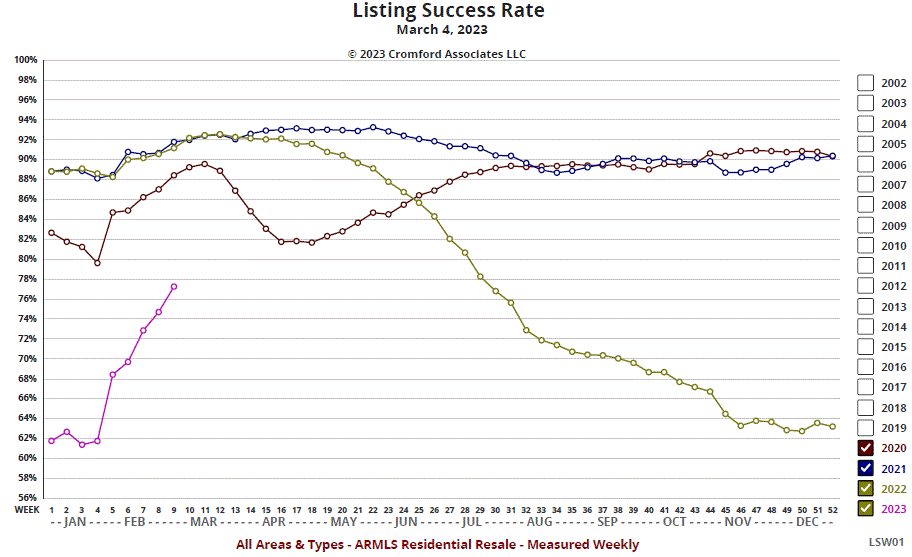
Look at the chart below and you can see how the listing success rate has improved sharply since week 4. A normal market generates a listing success rate of around 65%, whereas we are heading towards 80%, consistent with a market where supply is unable to keep up with demand.
Over the last 25 years, mortgage rates have gone through several fluctuations due to changes in economic conditions, government policies, and global events. In the early 2000s, rates were relatively stable and remained below 7%. However, the financial crisis of 2008 caused rates to drop dramatically, reaching historic lows in 2012, with 30-year fixed-rate mortgages hovering around 3.5%. Rates remained low for several years due to the Federal Reserve's monetary policy, but began to rise slowly in 2018 and 2019, reaching above 5% for 30-year fixed-rate mortgages. In 2020, rates dropped again due to the COVID-19 pandemic and the Federal Reserve's efforts to stimulate the economy, with rates for 30-year fixed-rate mortgages dropping below 3% for the first time ever. As of early 2023, rates have begun to rise again due to inflationary pressures and the Federal Reserve's response to them. Overall, mortgage rates have been historically low in recent years, providing an opportunity for homebuyers to lock in affordable financing.
What Does This All Mean For Buyers and Sellers? There is no denying that demand remains weak compared to normal, because affordability is poor. However the same factors that make affordability poor also make homeowners reluctant to sell their homes. Focusing exclusively on the demand side of the equation will make you sad. Look also at the weakness of supply, which shows no sign of improvement. With a decreasing number of homes going on sale, those that do have an increasing chance of a successful sale. We are recording fewer cancellations and fewer expirations. This is a positive readout, folks. And it is based on cold hard numbers not opinions of how the market "ought" to be behaving.
The volume may be low, but the market is operating with great efficiency and it is getting easier to sell a home, not harder.
Some or all information compliments of The Cromford Report.
Common Real Estate Terms, Explained
Whether you're thinking of selling or buying a home, there are many real estate terms that you'll likely hear throughout the process. Here’s a breakdown of what they all mean.
Appraisal: An appraisal is a third-party estimate of what a home is worth. When purchasing a home, lenders require appraisals to ensure they're loaning the right amount. If the appraised value is lower than the buyer's offer, the buyer may need to pay the difference.
Broker: A broker is a professional who has obtained a broker's license and understands construction, property management, and real estate law. Real estate agents are supervised by brokers.
Closing: The closing process is the last step of a real estate transaction. On this date, the property is transferred from the seller to the buyer.
Closing costs: These costs can amount to 2-5% of the home's purchase price. Examples of closing costs include appraisal fees and attorney fees.
Deed: A deed is a contract that transfers the title directly from the seller to the buyer.
Down payment: A down payment is the total amount of cash that the buyer pays at closing. Home loans have minimum down payments of 3-5%.
Earnest money deposit: This deposit is around 1-2% of the purchase price and is paid by the buyer when the contract is first signed. It's meant to show the seller you are serious about the transaction.
Escrow: This account is made when a third party holds an earnest money check from the buyer until the transaction is completed. Then these funds are sent to the seller.
Home inspection: An inspection is performed by a third party to identify a property's condition during the closing process. Inspectors will include information about the foundation's stability, the condition of a home's roof, and the state of any major home systems in their report.
Interest rate: This is the cost that the buyer pays to their lender to borrow funds over a set period of time. It's displayed as a percentage.
Lender: A lender is an individual or financial institution that's lending money to an individual buyer to purchase property. The loan will then be repaid with a certain amount of interest.
Mortgage: A mortgage represents an agreement between a lender and borrower that allows the lender to obtain the property if the borrower can't make their loan payments on time.
Pre-approval: Before you make an offer to buy a home, you should get pre-approved by a lender. The lender will check your credit history and income, verify all information, and approve you for a specific loan amount.
With these terms and definitions in hand, you should be better prepared to buy or sell a home. If you have questions about any of these terms or want an overview of what the process looks like for your specific situation, reach out anytime.
Your profile is almost complete! Just a few more details from you.
Sign Up
Go Back
By digitally signing this form you are providing with your express written consent to send you business and marketing communications via text messages (SMS), email, and by calls or prerecorded messages dialed by a natural person or by an automatic or automated telephone dialing system. This express written consent applies to each such email address or telephone number that you provide to us now or in the future and permits such communications regardless of their purpose, unless you opt out of SMS marketing communication when submitting this form. Consent not required to register. Message frequency varies, message and data rates may apply. Text STOP to cancel, call for help.